Showing posts with label tourism. Show all posts

Thursday, 31 January 2013

The Villa of Crossed Destinies


Gladiator Fight during a Meal at Pompeii, 1880, Francesco Netti
from Getty Museum website
We used the space syntax analysis software to investigate accessibility and visibility of space. We also tested from which points of the villa it was easy to see the mosaic and what areas of the villa were visible standing on the mosaic. But I’ll publish some screen shots and notes on that in another post.

I stared at the plan and went through my photographic documentation, trying to image that House, in the past. The little beautiful mosaic on the threshold of the fine room. Why? Why the mosaic was there and not in any other place of the villa? What was its purpose? The truth is that we don’t know.
But is that really a problem for the audience?

Many professionals in museum and site management seem to believe that visitors couldn’t cope with uncertainty. Maybe they feel it would undermine the authority of the museum or cultural institution. I don’t think so.
Let me use an example to make this point clearer. In her popular book about Pompeii, Mary Beard complains about a famous Pompeian “fact” that I have actually found in more than one touristic guide. The anecdote is that the body of a very wealthy woman, wearing fine cloths and expensive jewellery was found in the Gladiators barracks, close to the body of a handsome fighter. It is easy to join the dots and put together a steamy story about luxurious ladies visiting their secret lovers: fearless men who faced death everyday but, apparently, were also very keen on enjoying life. The catastrophe of the Vesusius caught them in the middle of a passionate meeting. To me, it sounds like something between a Hollywood peplum and a Barbara Cartland novel. However, the story per se is quite effective and often makes the tourists smile.
Unfortunately, the story in not true. Or, at least, not complete. None of the books citing (or just repeating) the  story says that, in the same barracks, other 18 bodies have been found. This information changes the scenario completely. Assuming that they were not a club of voyeurs, it is more likely that, during the scary and confusing events of that day, people of different social status sought shelter in the same place. We could even add that she was wearing so many jewels not to impress her lover but because, as many other inhabitants of Pompeii, she was trying to flee carrying on her body at least her most valuable goods.
But this is just another hypothesis. Perhaps more grounded than the other one. What is certain is that we don’t know.

The Castle of Crossed Destiny,
Cover of the first edition
I believe that the possibility to imagine one (or more) hypothetical story, starting from the historical and archaeological information available, can be seen as an interesting task and not a limitation by the audience. As a visitor, I wouldn’t like to listen to a ready made story that is presented as “a fact” while not only it is just an interpretation but is also based on a (non declared) selection of the available information.

According to many scholars in Museums Studies and Public Archaeology (such as Witcomb, Parry and Copeland), the best way to engage the audience is to involve them in the production of meaning. Of course members of the public are not archaeologists or classicists. But if they knew what was found in an ancient place, let’s say a house or a cubiculum in the barracks, they could apply what Merriman  calls ‘informed imagination’. They can’t develop scientific interpretation. But, for sure, they can imagine stories starting from the pieces of information they have received.

That’s what I wanted to do with the dog mosaic.
When I was trying to explain my idea to my supervisor, I told him something like: “Imagine each bit of information we have about the House of Orpheus is a card. You have multiple combinations available, you have multiple potential stories.” While I was speaking, I visualised the pages of a book by one of my favourite Italian writers, Italo Calvino. The book is called The castle of Crossed Destinies and it’s part a collection of short stories, part a mind blowing essay on semiotics. A group of travellers are gathered together but, for a mysterious reason, they cannot talk. The only means they have to communicate (and entertain each other) is using a deck of Tarots to build their stories visually. 
One of the interesting aspects is that each card is used more than one time and with different connotations.

Let’s go back to the House of Orpheus.
If we consider, for example: 
the small mosaic with the dog, 
the fact that the dog does not look like a guard dog but more like a pet, 
the fact that room 9 is exquisitely decorated, 
the fact that Vesonius Primus had his garden decorated with a large fresco with Orpheus and the animals, 
the fact that he received an herm from his workers as a sign of gratitude 
we could say that Vesonius was a gentle hearted person who treated his workers and slaves fairly. He also loved poetry and nature (like Orpheus), especially animals. So much so, that he was very fond of his dog and dedicated an entire room of his house to it. When he left the House to save his life, a major cause prevented him from freeing the dog, who met a sad end. 

The Castle of Crossed Destinies
Or we start from the fact that Vesonius received a herm from his workers and change completely its connotation, connecting it differently to the other bits of information we have.
We could think that Vesonius was a mean and tyrannic master. Not only he made almost impossible for his slaves to buy their freedom but also obliged them to spend a lot of money in a “spontaneous” gift of gratitude. The dedication of the herm should be read, in this case, as slightly ironic in spite of its respectful words. Perhaps Vesonius loved his dog more than his human workers (it wouldn’t be that strange for an ancient Roman) and the dog was indeed very much hated in the house as he received better care, food and shelter than many people there.
Maybe when Vesonius left the house he put one of his slave in charge of protecting it from thieves but the slave, understood the situation, escaped leaving the dog at guard of the house. With not a lot of regrets.

Combinations are almost endless. There isn’t one that is more correct than another. Probably none of them would be “what actually happened”. But that is not the point. I believe that trying to build a story is an effective way to invite the public to gather as much information as they can, to put things in context, to empathise with the people that used to live in ancient cities, to understand better what studying the past means.

By the way, we started feeling sorry for the poor dog that dies at the end of each of these stories. So we gave him a name: is called Morty :-)

Thursday, 3 January 2013

"we were all the more vividly transported into the past"

Kitchen utensils found in Pompeii
From The Wonders of Pompeii available
on The Project Gutenberg
On site, buildings on their own look empty and it is difficult to imagine them as lived spaces. In museums, objects on their own are abstractions, not entirely comprehensible. But when they are connected (and connected with their context) they offer a much more valuable experience to the visitor. 
Unfortunately, putting them together (creating a link between the city and the artefacts) requires a big effort of visual imagination, especially considering how little information is available both on site and in museums to help the user.

When I went to the Museum of Naples for the first time, one of the museum staff members claimed that the ideal user experience should be: going to Pompeii, then visiting the museum of Naples and last going to Pompeii again. 
It is exactly what I did for my research: I went to Pompeii, to Naples and again to Pompeii in a few weeks time. Actually, the experience was so exciting I decided to spend my next 4 years studying it! However, how many tourists and visitors are likely to do something similar? Very few indeed. This is why I think digital unification and virtual museums are successful approaches to deal with a problem that can only be solved in the digital space.

As a support for my thesis, I’m borrowing the words of writers much better than me to describe on the one hand the frustration of the tourist in Pompeii and on the other hand how much the experience of the artefacts can enrich the perception of the buildings (and viceversa). 

Pompeii, the Small Theatre
From The Wonders of Pompeii available
on The Project Gutenberg
“I might tell you of a pretty picture on a rich mosaic in such-and-such room. You would go thither to look for it and not find it. The museum at Naples has it, and if it be not there it is nowhere. Time, the atmosphere, and the sunlight have destroyed it. Therefore those who make out an inventory of these houses for you are preparing your bitter disappointments. The only way to get an idea of Pompeian art is not to examine all these monuments separately, but to group them in one’s mind, and then to pay the museum an attentive visit.”

The Wonders of Pompeii, Monnier, 1867

“we were all the more vividly transported into the past, when all these objects were part and parcel of their owner’s life. They quite changed my picture of Pompeii. In my mind’s eye its homes now looked both more cramped and more spatious - more cramped because I now saw them crowded with objects, and more spacious because these objects were not made merely for use but were decorated with such art and grace that they enlarged and refreshed the mind in a way that the physical space of even the largest room cannot do.”

Italian Journey, Goethe, 1816 

Wednesday, 26 December 2012

Museum of Naples: complaints department #2

Mueum of Naples, Mosaics Collection
From the Museum's website
There is one last complaint that does not come from the people I interviewed but from my personal experience and was highlight by my current research.
No information about the relationship between objects: sometimes different objects come from the same house, but the visitor is not able to see the connection. In some cases the objects are physically dispersed, like the mosaic of the guard dog from the House of Orpheus (exhibited in the Museum of Naples) and the plaster cast of the dog (from the same house but exhibited in the Antiquarium of Boscoreale), but even when they are in the same museum the relationship is not explicit for the visitor.

On the contrary, sometimes it seems that misleading connections are accidentally suggested by the use of exhibition's space. As Parry remarks, space in museum is part of the communicative process. Proximity implies meaningful connections between items. 

For example, I went to the Archaeological Museum of Taranto (MARTA) yesterday and I couldn’t initially understand the display's criteria. Then a guide explained that the different objects exhibited together came from the same burial. The curators had also added ancient statuettes or paintings illustrating how the found ear rings, buttons or fibulae used to be wore. Having received that information everything made much more sense to me.
Unfortunately, I wasn’t able to work out what are the display criteria in the Museum of Naples. For example, floor mosaics are exhibited next to wall mosaics (as fountains or nymphea’s decorations). To be honest, sometimes the criterion seemed to be simply chromatic similarity or aesthetic pleasantness.
Actually, the Museum's website says that the mosaics are exhibited according to the building materials and techniques. However, this information is not accessible during the visit of the museum.

It is not my intention to criticise the museum’s management because I understand that is very easy to judge and much more difficult to deal with such a complex situation. However, I can’t help thinking of how much of the potential of one of the most interesting museum in the world is partly wasted. 
Furthermore, if the site of Pompeii can still live on its fame, aura and unique history, I believe that the Museum should definitely invest in the quality of the information it is able to deliver.

Museum of Naples: complaints department #1

G. Sommer, Ancient Vases in the
Archaeological Museum of Naples
from wikipedia
So far, I have written notes about Pompeii and the absence of the artefacts on site. What about the ancient objects found in the ancient city? Are the visitors of the Archaeological Museum in Naples more satisfied than the site’s ones?
Apparently they are not. 
Even though all the visitors I have spoken with recognised that the Museum shows interesting items, they were all disappointed (to different extents) by their visit.
The followings are the most common complaints

Language: almost everything is written in Italian. If the visitors don’t want to pay for an audioguide, there is no means to access even the most basic information in a language other than Italian. Considering that the Museum is visited by a very international audience this is very difficult to accept.

Brief and generic descriptions: even Italian visitors were disappointed by the information delivered in the museum, not because of the language but because they found it not sufficient and too generic. The labels are scarce and sometimes just made of two or three words (for instance: “vase, Pompeii”).

No information about use: it is difficulty to understand how everyday-life items were used. Not only surgical tools but even kitchen supplies remain somehow mysterious. The visitors can observe the objects but, because it is impossible to imagine their function or their context of use, the audience tends to loose interest in them.
In my opinion, this is really a shame as everyday-life items can be seen as the highest value offered by the archaeological site of Pompeii. In fact, if it is more likely that exceptional items survive because they are valuable and people take care of them, everyday-life objects often disappear completely. Moreover, Pompeii is one of the best places to analyse those objects in a richer context.

G. Brogi, Surgical tools in the Archaeological Museum
of Naples. From the Alinari Collection
The ones listed above were the impressions that my volunteers spontaneously communicated to me. Then I asked them few specific questions focusing on the topics more closely related to my present research. For example, I tried to understand how easy was for the public to establish a connection (both cognitive and visual) between the artefacts and the provenance building. There was a general agreement on this subject and here follows a sum up of what they told me [plus my comments in square brackets].

Little or no information about provenance: the provenance of the objects is not always stated. Often the labels just say “Pompeii” or “Herculaneum”. In some cases the provenance of the artefact is identified with the code of regionis and insulae set by Giuseppe Fiorelli. 
[I believe this choice is already disappointing for visitors who know a little bit of the toponomastic of Pompeii but I find it quite unsuitable for general public. Fiorelli’s code is precise and clever and it is very useful in archaeological excavations, records and studies. However, I don’t think it was meant for communicative purposes. Moreover, considering how peculiar and evocative are the names of many of the houses in Pompeii, using them might allow more people to connect the items with the place they come from.]

Little or no information about the context: not only it is often very difficult to establish a relationship between the object and the building, but also between the object and its context. 
[Mosaics for example, are usually exhibited on walls and there is no mention that they used to be floors’ decoration. Contextual information is almost completely missing. Speaking of mosaics, that are one of my specific target, there is very few information about how they were built, why they where used to decorate spaces, in what kind of houses and rooms they have been found etc... I believe this kind of information would definitely make the object more interesting in the visitor’s eye]

Sunday, 9 December 2012

Pompeii: complaints department #1

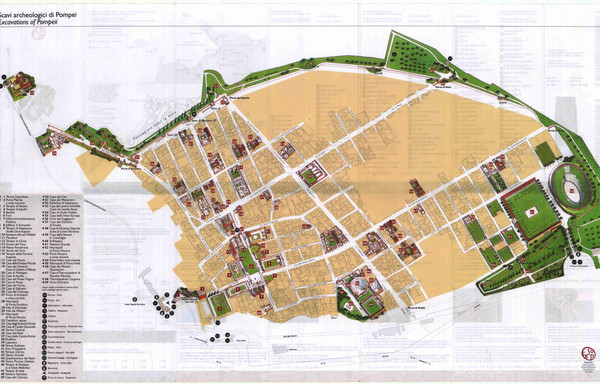
Map of the Pompeii available for free
with the entrance ticket
I am preparing the questionnaire I will give to the visitors of the British Museum and make available online for other volunteers.
In the meantime, I want to transcribe some notes about the first information I gathered, very informally, from 
* people I met on site and during my visit at the museum of Naples 
* people I have met in the subsequent days but have agreed to share with me their opinions and experiences.

On site:
People tend to arrive on site with a high level of expectation. Everybody knows about the tragic end of Pompeii and everybody knows that it is one of the most precious archaeological resources of the world. 
I have approached tourists that were not part of a guided tour for obvious reasons. Often they were couples. Some of them had a published touristic guide, others just the leaflet that the ticket office gave them. 
They all appreciated the opportunity to wander freely in the site (they often defined it as “a wonderful opportunity”) but, on the other hand, they all lamented a certain lack of information.
Having some of them long and detailed touristic guides, my reckoning is that they were not just looking for more written information. A couple I interviewed in Herculaneum explicitly said that they don’t like (and didn’t expect) informative panels because they spoil the archaeological landscape. Moreover, I would add that it is very difficult to deal with all the languages spoken by tourists in Pompeii (or even just with the 2 or 3 most common ones). 

One of the most frequent complains I have heard was the difficulty in perceiving the Pompeian dwellings as places that used to be “lived”. All the visitors I have interviewed were, to a certain extent, looking for a sort of emotional experience. But, for a tourist (even a motivated one) it is hard to understand how spaces were used in the past. This seems to provoke a certain level of frustration. Tourists would have liked to see objects (even reproductions) and furnitures in the houses. Some of the interviewed people have even asked me to explain why none of the objects have been left in place. When I told them that original artefacts would be damaged or nicked if left in place, they asked why not even reproductions are now available.
The truth is that is not easy. Pompeii is a large and complex site, very difficult to manage. Every choice seems to make someone unhappy and finding a balance between authenticity and communication is a real challenge.

My intention is not to criticise the policies of the site management, but to report what I have heard from tourists. One of them, for example, suggested that at least one exemplar house should be restored and refurbished to show how they used to be.

One of the most precious information for my research is that, apparently, what tourists miss is both cognitive and emotional. They would like to know more, to understand more. At the same time, they want to “feel” that they are walking the streets of what used to be a city with passers by, sellers, customers, children, animals etc... This is probably why they feel that a book or a panel would not be enough. Objects, on the other hand, appear to have a strong emotional and communicative value. From these first results, it seems that is through objects that the connection with the past works better. 
Probably looking at objects, tourists can imagine ancient inhabitants of the city using them in their everyday life. Or, more simply, the presence of objects is what identifies a space as a domestic space (or a ritual one or a commercial one and so on but always as a "human" space).

Thursday, 6 December 2012

"Pompeii in Fact and Fiction": places as ideas


Portrait of Winckelmann by A. von Maron
I found Pompeii in Fact and Fiction by Wolfgang Leppman when I was working on my MA dissertation (the digital unification of the Temple of Isis in Pompeii and the related frescoes). It has proven to be useful and interesting for many reasons.
In the first place it states, already in 1968, that Pompeii is, at the same time, a geographical place, an historical site and the sum of many interpretations. So much so, that it is often impossible to say when one ends and another begins. If this can be considered problematic by many hard archaeologists, it is to me one of the (many) reasons that make Pompeii a unique place and the ideal candidate for digital projects aiming to deliver complex (i.e. multilayered) information.

The book shows chronologically how tourist’s expectations have been changing during the years. Summarising  roughly, he identifies at least three major trends. 
According to Leppmann, during Neoclassicism tourists expected to see in Pompeii magnificent relics, consistent with the idealisation of the Roman period they had developed during their reverential study of the Classics. It is easy to imagine how disappointed they were when they saw small dwellings or little, asymmetrical temples as the Temple of Isis. This impression was amplified by the absence of most of the large Pompeian villas (still to be uncovered). As Leppamnn remarks, words like “smallness” “narrow” “doll’s house” “mummified” appear often in the first reports.
However, Pompeii (and Herculaneum even more) provoked the enthusiasm of all the art lovers, and influenced a whole trend of figurative art, fashion and interior design.

Madame de Stael as Corinne,
by F.P. Gerard
There is a big change in tourists’ attitude and expectations during the Romanticism. Leppmann identifies the turning point in the publication of the Madame de Stael’s novel “Corinne”. It is probably just a convention and, apparently, the novel itself is more relevant to reception’s studies than to literary ones. However, this is the first famous work of art in which Pompeii is not used as a subject for scholarly descriptions and investigations but as a set for a love story. What is even more important and innovative is that the informative value of the site is definitely less important, in the eyes of the characters (and of the author’s, I assume), than the indefinable emotional connection with the past that they feel there. 
The Neoclassical attempts to visualise how the place might have looked like, are not part of de Stael sensibility (that Leppmann uses as an indicator of the whole Romantic sensibility). The charm of Pompeii is in its being a ruin, a sad relic of a faded past. Tourists go there not to learn about ancient lives but to be touched by their memories and to reflect (very Romanticly) upon caducity of life. This is also why isolated and marginal places (even better with a good view on the terrible Vesuvius) are preferred to functional places like the forum or the basilica. 

Later on, always according to Leppmann, Pompei becomes more and more a literary place, a sort of flexible narrative space that only partially coincides with the physical one. Many novels tell stories about Pompeian ancient inhabitants (living or ghosts) and Pompeii consolidates its place in social imaginary. 
Screenshot from the movie
"Viaggio in Italia" by R. Rossellini
Plus, in the growing trend of oneiric, symbolic and even psychoanalytic novels and short stories, Pompeii became something like an emotions trigger. Its strong and almost violent connection with love, death and sex provokes in the characters intimate experiences, so much intense that sometimes they are simply unbearable.

What is Pompeii today? A source of information to understand ancient art and history? A place where it is possible to experience an emotional connection with past lives? An almost archetypical element of the social subconscious? The crossing point of hundreds of stories?
All of the above and even something new?

It is practically possible to put all this information together and display it in a meaningful way?